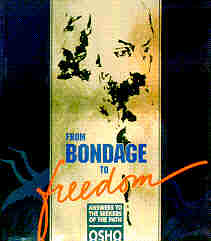
From Bondage to Freedom
Discourses
Table of Contents
To be ordinary is the most extraordinary thing in the world
Mediocrity is humanity's retardedness—vested interests want you unintelligent so you can be exploited. Society hypnotizes you into feeling extraordinary to keep you mediocre. To understand you are mediocre is a great jump. Ordinariness is the natural person; nature produces unique, not special, people.
The work of the serpent
Sheela's hatred of Indians stems from being raped at fifteen by her father's friend. She surrounded herself with homosexuals—neither men nor women. She persuaded Osho to leave India, but her real motive was escaping the land of her trauma. Osho is the only Indian she didn't hate.
Learn from this experience
The roseflower is fragile but serves life; the rock is hard but serves death. Innocence can be exploited, but no harm is done to you—fragrance may last a moment, yet that moment is eternity. The higher you go, the more delicate you become. A fascist calamity happened because lovingness was taken advantage of.
Where do we go from here?
Where do we go from here? Nowhere—we stay. The relief after Sheela left was followed by trauma: dependence becoming independence. Those who remained revolted against Sheela. Even if Sheela and her gang ask to return, welcome them—their intention was never bad, only their means. Love knows no resentment.
The future is open
Meditative people cannot be corrupted—Sheela was never meditative. She came for her husband Chinmaya's cancer; he meditated and lived ten years beyond medical prognosis. Sheela betrayed him with lovers while he was sick. Power corrupts only the unmeditative. Organization of meditative people must be based in awareness.
The meaning of responsibility
Responsibility means doing your best so no dictator is needed. Without Sheela, people stop working, want to vote on everything. You created Sheela by your dependence; without responsibility you'll create another. Sheela was one side of the coin; you are the other. Don't be the tower of Babel.
Love is not surrender
Light and darkness are one—just degrees of the same phenomenon. Aristotle divided existence into contradictions, crippling Western thought for two thousand years. He even claimed women have fewer teeth than men without counting. Complementaries, not contradictions. Drop Aristotelian logic to comprehend the wholeness of life.
Intelligence is a luxury
Christianity and Hinduism both pervert sex through celibacy. Hinduism invented celibacy ten thousand years ago; tantra was born as rebellion—making sex spiritual. Celibacy creates inner conflict, weakens you. Tantra uses orgasm's natural moment of no-thought as a gateway to meditation. Orgasm has nothing to do with the other.
Intelligence is a luxury
Your love is full of hate, jealousy, anger. Don't call me 'Beloved Master'—those words become poisonous. You are angry at me because you projected a father figure. You behaved like idiots under Sheela—five thousand intelligent people couldn't see poisoning and murder being ordered. Be angry at yourself.
Struggling for the new man
Judas sold Jesus for thirty silver coins—sannyasins still behave the same. Darwin's evolution is flawed: apes don't become men. America assassinated its best presidents. Average mental age is thirteen. Politicians and priests conspire to keep man retarded, always searching for father figures. The new man is the goal.
The dewdrop has disappeared into the ocean
The real master is only a presence—no intentions of being a master. His presence is his teaching; he is a window to the infinite sky. The dewdrop has disappeared into the ocean. He has no creeds, no dogmas—he gives freedom, not slavery. The disciple comes closer to the same qualities: nonexistence of ego, overflowing love.
Today we claim the rainbow
Nobody can betray me—Jesus asked for faith, I ask you to believe in yourself. Sheela betrayed her own spiritual growth. Those forced out by Sheela still love me and want to return. Sheela was a waitress before I made her queen. Puja was the mastermind—forcing doctors to sign illegal prescriptions. Love should be forgiving.
The world needs to be one
Zorba the Buddha acts individually, rebelliously. Revolution is for crowds and changes things without bettering them; rebellion is individual, conscious, out of love. Sheela's gang fled without even saying goodbye—Zorba the Buddha's action is so silent you become aware only when it's complete. Sheela gave an interview: 'To hell with Bhagwan.'
No master, no disciple
One Sheela doesn't change my respect for women—Hasya and Anuradha prove it. Men produced Hitler, Stalin, Genghis Khan. Sheela was sick, needs compassion. Vivek served fifteen years with immense devotion. Two billion women cannot be judged by one. Sheela was made president because Oregon was hostile to strangers.
Now meditation is needed even more
Humor and nonviolence—would a lazy man hijack a plane? The attorney general put the National Guard on alert over jokes. Our joy, laughter, meditation are bigger forces than nuclear weapons. They can kill bodies but not spirit. I am preparing you for when your spirits are free—no visa, no passport needed.
This existence is paradise
This is religiousness, not religion—conversion is fanatic and trespasses individual freedom. All missionaries are businessmen selling invisible things. Anger at non-converts arises because your truth is belief, not experience. Truth needs to convert nobody. I've never followed anybody; I'm not part of any ideology.
You just need a little courage
Arrest me—it will destroy American hypocrisy about democracy. America has the best Constitution but the worst politicians. Three and a half years in silence, still a criminal. Five thousand sannyasins will volunteer to be arrested. We don't read history—we make history. The beginning of the end of American phoniness.
Existential worship
Work is imposed; worship is what you love to do—creativity. When the worker is lost, only worship remains. Digging a ditch can be worship if ego disappears. Religions confine worship to churches for one hour; I want worship to become twenty-four-hour, like breathing. The whole earth is holy ground—Moses was told 'Take off your shoes.'
A mystic versus America
Rajneesh Mandir's name—this is the only direct democracy in the world. The commune voted to keep the name. The questioner wouldn't stand up—no guts. This commune is direct democracy; all other democracies are indirect, just Rotary Clubs. Once you choose representatives, you become slaves for four or five years.
The power of the mystic
Total trust includes guns as thorns to protect roseflowers. Three dozen guns against a world of nuclear weapons—why is America afraid? Guns were needed against Hell's Angels and fanatic Christians. Don't be naive about life's struggle. Remember only: you are not on the destructive side. To allow harm is as ugly as harming.
Your work should be your joy
This is a mystery school—people can't see it because mystery is incomprehensible to the ordinary mind. Socrates: as a youth he knew everything; mature, he knew little; dying, he knew nothing. Plato made two categories: knowledge which is ignorance, and ignorance which knows. The mystic's clarity: the seer disappears, only seeing remains.
This whole earth belongs to us
You can only betray yourself—nobody here asks for faith. In the outside world you can betray Christianity, communism. The seed of betrayal is sown in obedience. God created the situation for Adam and Eve's betrayal—he's a fascist. This commune is individuals, totally independent. You are welcome to come and go. Fulfill yourself or betray yourself.
Religion is dead, religio is born
God never existed—his death means the lie is dead, the fiction is dead. With God dead, priests become irrelevant. Religion is alive when individual, dead when organized—Christianity, Hinduism, Buddhism are all dead. Religio is born: individual inquiry, no belief system. God was a fascist dictator, a projection for a father figure.
Learn the art of living
Kahlil Gibran's despair—artists project dreams, not reality. THE PROPHET is beautiful but Gibran himself lived in anguish. Whatever you miss in life, you fulfill in dreams. His ego prevented love. Never meet unenlightened artists—their writings show dreams, not living reality. They were utter failures as beings, though genius as creators.
The buddhafield remains
Innocence is the ultimate flowering of consciousness—even a child is merely ignorant. Bodhidharma: 'I do not know.' Socrates: 'I know only that I know nothing.' Stupidity never looks inward but sees others' faults. A Hindu can't see Jesus enlightened; a Christian can't see Krishna. The buddhafield remains—innocence is discovering you know nothing.
Truth is enough unto itself
Truth needs no defense; only lies need missionaries. Don't try to convince—make your experience available naked, without logic. Truth comes through the shine of your eyes, your presence. You can't convince a man with closed eyes that there is light, but you can create an urge to open them. Truth is self-evident.
Close your eyes and find me
Nobody can betray me—I ask you to doubt, be skeptical, rational. Sheela betrayed herself. She did good work but also committed crimes: attempted murder, bugging 145 rooms, taping phones. Nixon looks like a pygmy before her. One crime destroys ninety-nine percent good work. Be grateful for the good, but don't forgive the crimes.
You are eternal
Power and force never become one. Power radiates from within—love is power. Force is violent, a trespass on freedom. A president has force, not power. Power heals, enhances dignity; force destroys. Love is power, but marriage turns it to force—law enters where love disappears. Power opens doors to the transcendental.
Truth -- not a highway but a hill track
God is the greatest lie ever told. His death means the fiction is dead—no corpse remains. Religion is alive when unorganized, individual, based on inquiry. Dead when organized—Christianity, Hinduism, Buddhism. Truth is not a highway but a hill track. Finding the way yourself crystallizes you. No hierarchy, no dogma—just your own inquiry.
This beautiful earth
The court oath is superstition. In dark ages, fear of hell made it work. Today it serves the lie—your oath makes lies accepted as truth. Holy books are third-rate fictions. A man should be accepted on his own authority. Lie detectors are scientific: lying changes heartbeat rhythm. The oath is an outdated device exploiting conditioning.
Democracy means mediocracy
Every child is told he's not what he should be—inferiority complex is the basic mind disease. Assertiveness is the attempt to prove worthy according to others' expectations. If you succeed, you've betrayed your nature; if you fail, you feel inferior. No individual is higher or lower. Democracy means mediocracy—equality is unpsychological. People are unique, not equal.
The great accident
Priests and lawyers are unnecessary mediators. The priest creates division between you and existence, then exploits it. You don't need a mediator to see a sunrise. The lawyer camouflages truth in jargon—Mao eliminated lawyers in China; the judge can listen to both parties directly. The whole profession prolongs cases for years to extract money.
Dismantle the ego
Empathy is beyond sympathy and apathy. Ramakrishna felt a fisherman's beating—same bruises appeared on his back. Empathy means the other is no longer other; a secret passage opens between two beings. Sympathy secretly feels superior. Empathy dissolves boundaries—the other's thirst, hunger, joy becomes yours. Dismantle the ego to become capable of empathy.
The sound of truth: Aha!
I don't answer all questions. Head questions burden the mind—I choose those that unburden. Belief questions I cannot support—know, don't believe. Curiosity questions don't deserve answers—this is a mystery school, not a curiosity shop. The monkey mind asks without thirst. I answer only questions born of longing, not itching.
Existence is only in the present
Don't think of the future—live here and now. Thinking of tomorrow keeps man tense, worried. What I impart is important, not me—millions have died, life goes on. If you want to fall back into misery, it's your choice. The people who learned living moment to moment will continue wherever they are. Existence is only in the present.
To each his own song
Socrates was a mystic, not Western—spiritually he belongs to the East. The West developed from Aristotle, not Socrates. Therapy means 'know thyself'—the therapist creates situations for self-discovery, not teachings. Self-respect is the first condition—all religions condemn you, create guilt. To each his own song: bow down to the other's godliness.
Doubt is absolutely okay
Rebellion is individual, nonviolent, out of love. Revolution is organized, violent, against something but not for anything. Revolution fights the past; rebellion meditates for the future. Organized revolution becomes the same establishment it opposed. Even single individuals meditating can transform society—their love cannot fail. Rebellion has not been tried; revolution always fails.
Enough just to be with me
Beyond psychotherapy is your real being. Psychotherapy is confined to mind—you are not the mind. Psychotherapists are the most mentally sick profession: most suicides, most madness, most sexual perversion. They can bring you back to normal insanity. Man is three layers: body, mind, being. Mind is a good servant but a terrible master.
Every child is born a witness
Everything of authentic value arises from meditation—no-mind. Art, music, poetry, dance, love are born of meditation. Hate, anger, jealousy, war are born of mind. Write down your mind for ten minutes and you'll see madness. Psychotherapists use 'love-hate' as one word. Machiavelli advised kings: never tell a friend what you wouldn't tell an enemy. Every child is born a witness—society destroys it.
Without Zorba there is no Buddha
Zorba the Buddha is possible—religious leaders couldn't think of it because it would end their leadership. Religions split man into fragments to enslave him; a whole man is beyond control. Zorba the Buddha ends all religions—enjoying the air, sea, sand, sun. There is no other God than existence itself. Without Zorba there is no Buddha.
The psychology of the buddhas
Man is a seven-story building. Freud found the conscious and unconscious; Jung found the collective unconscious; the East found the cosmic unconscious below. Above: superconscious, collective superconscious, cosmic conscious—enlightenment, buddhahood. Western psychology studied sick people; Eastern psychology studied meditators. The psychology of the buddhas is the only complete psychology.
Everything beautiful is absurd
I am a guide, not a leader. 'Leader' stinks of politics—Jesus saying 'you are sheep' is fascist. The guide tells his experience but every individual is unique; you create your own path by walking. A leader makes you smaller to make himself bigger. Priests are called 'father' to keep you childish. Everything beautiful is absurd—freedom has no ready-made path.
The blessed ones
Only a psychology of the buddhas is possible—the man in mind cannot study mind objectively. A madman can't research madness. Freud, Adler, Jung all created fictions—that's why there are contradictory schools of psychology. The awakened one sees from the hilltop into the dark valleys of mind. He has no prejudices, no ideologies. The blessed ones are those who have gone beyond mind.