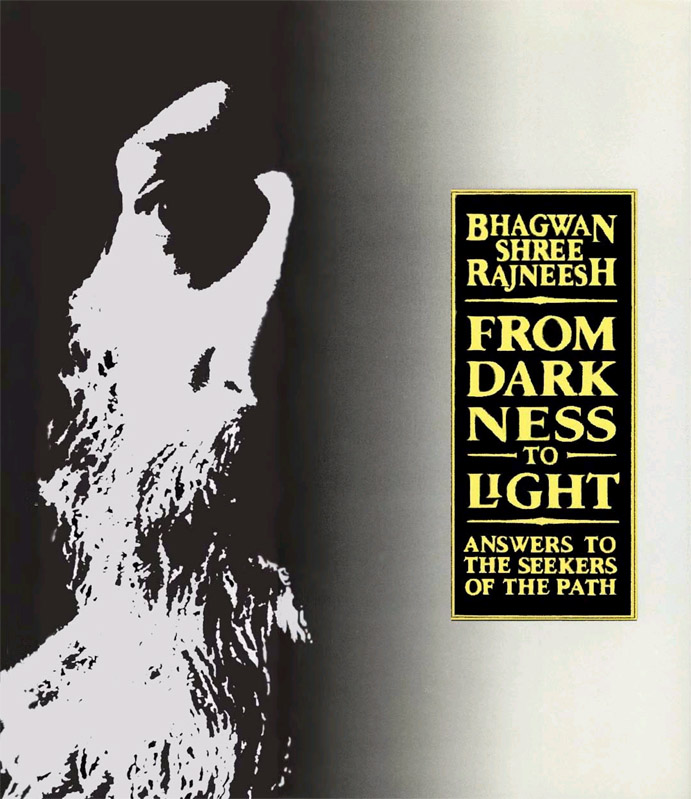
From Darkness to Light
Discourses
Table of Contents
Who says humanity needs saving?
Humanity doesn't need saving—the 'original fall' is fiction; man has been evolving. Religions invented the fall to justify saving. Darwin's evolution could be the only 'fall'—monkeys falling from trees. Monkey hierarchy: chief at top, harem, then brownnoses (chamchas). Humanity grew from the poorest monkeys.
Innocence: the price you pay for the failure of success
Innocence is courage and clarity both—not something to achieve, but born with. You enter the world as a tabula rasa: no past, only future. The past makes you cunning but not intelligent. The world is a waiting room; you take only what you brought in. All worldly success means nothing compared to inner failure.
Help your child -- protect him from yourself!
Every way to help a child is wrong—the very idea of helping is interference. The child's natural potential is unknown, so you can only not interfere. In the name of help, everybody interferes. Mind lives on interference; power is measured by how many lives you can interfere with. Help your child by protecting him from yourself.
The death penalty: not punishment but revenge
The death penalty is not punishment but revenge—proof of man's inhumanity. If you can't give life as reward, you can't give death as penalty. Life imprisonment is worse than death—dying slowly for fifty years. The story of the escaped criminal who returned twelve years later with the dead body of the man he was accused of killing. Innocence has no proof.
Successful criminals and cowardly politicians
Political and religious leaders are fundamentally the same—both driven by inferiority complex and will-to-power. Mind is not intelligence; intellect is mechanical, borrowed, a poor substitute. Scholars prove slavery to the establishment for prizes. The intellectual is phony, a beggar; the intelligent person is a rebel. Successful criminals become politicians; cowardly ones become priests.
Every child's original face is the face of god
Every child's original face is the face of God—conscious but without thoughts. God is not a person but a presence, subjectivity not object. The child's eyes are abysmal; conditioning destroys that depth. The child has no past, no problems—cannot think. Conscious without thoughts is the original face. Success makes the same child stink.
Time is very short but my methods are very quick
I can only answer for myself—'we' is for politicians and priests who represent crowds. The individual uses 'I' in lower case, not ego. My commune is not a crowd but a communion of individuals. From far away you see a forest; up close, only trees. Time is short but my methods are quick—I cannot promise we have enough time, only that I will do my best.
Agony is missing yourself, ecstasy is finding yourself
Agony and ecstasy are the same—complementaries, not opposites. Pain, suffering, misery are superficial ripples that come and go. Agony is not separate from you—it IS you. Expectation creates frustration. Ecstasy is finding yourself; agony is missing yourself. The pole of agony and ecstasy swings together—you cannot have one without the other.
Your suffering makes you special
Suffering is difficult to drop because it's your only companion—without it you're utterly lonely. The professor couple who fought constantly gave Osho a lifelong earplug addiction. People cling to misery because it's familiar; dropping it means facing loneliness. There's no painkiller for loneliness. Your suffering makes you special—the ego feeds on it.
Not spiritual guidance but spiritual presence
There are no absolutes in life—Einstein's relativity destroyed scientific certainty. Exceptions mean freedom. Science thought the world was a mechanism; relativity revealed it's an organism. Spiritual guidance is not an absolute necessity—what is needed is spiritual presence, not guidance. The master's presence, not his guidance, transforms.
Science and religion -- two petals of the same rose
Science and religion are two sides of the same coin—no synthesis needed. Science is observation outward; religion is awareness inward. Science is experiment; religion is experience. The subjectivity of consciousness and objectivity of existence are interdependent. The idea of synthesis already accepts they're opposed—they're not.
A single humanity rejoicing
Religion is not geography—neither Eastern nor Western. Meditation, love, compassion, intelligence are universal. Politicians and priests need divisions; without them they disappear. The next conflict may be South versus North—poor versus rich, black versus white. A single humanity rejoicing: meditation is the same everywhere. Don't divide the indivisible.
Truth is found in your own boutique
Religion and state must remain separate—pseudo-religion is superstition, not religion. Christianity, Hinduism, Islam are cults exploiting humanity. A religious person has no power; organized religion has its own generators. Science has earned its place by contributing to welfare; religion has been a curse. Truth is found in your own boutique, not in the state.
The best government is no government
The best government is no government—government is the ugliest, dirtiest game. Politicians create fear of anarchy, but in five thousand years governments have fought five thousand wars. They exploit, set people against each other, and need continuous war to exist. The dream of all enlightened ones: one day humanity gets rid of all governments.
The sweet taste of corruption
I've never spoken against God—who doesn't exist. Christianity is really Crossianity: worship of the cross, fear of death, not love of life. Remove crucifixion and resurrection and Christianity disappears. Buddha never made wine from water. Timothy Leary served seven years in jail for teaching LSD could boost consciousness. The sweet taste of corruption is truth to the young.
Till you live life totally
Life is its own goal—the goal is intrinsic, not outside. The idea of goal is future-oriented; tomorrow never comes. You sacrifice today—your only treasure—for imaginary paradise. All cultures and religions are against 'now.' The desire to live forever comes from not living at all. Till you live life totally, the desire to continue remains.
Love is a very unscientific idea
Science is only a means, not an end—must be guided by something higher. Science deals with things, not being. The scientist is a being himself but his methodology denies consciousness. You can't put consciousness in a test tube or dissect it. Love is unscientific but real. Science without consciousness becomes destructive. Being is indivisible—no sword can cut it.
Meditation: the door from slavery to freedom
The outer world is ruled by laws; the inner is pure freedom. Consciousness knows no laws—matter needs laws to hold together. H2O cannot become H3O; hydrogen has no freedom. Science discovers laws because it deals with dead matter. Meditation is the door from slavery to freedom. Consciousness can exist only in absolute freedom, with no limits, no conditions.
Where nothing is right and nothing is wrong
There is no universal right and wrong—divisions dissolve in universal consciousness (not-two, non-dual). Right and wrong are local, cultural, contextual. Mohammed's four wives made sense when men were dying in wars. People get addicted to rules and forget the circumstance. Universal consciousness is beyond morality—where nothing is right and nothing is wrong.
Don't drop -- transform!
Don't drop—transform! The ego is not separate from misery; the dropper IS the dropped. You can't drop misery because you are the misery. Desiring joy creates misery; the same desire now wants to drop it, creating more misery. Don't drop anger, greed, jealousy—transform them. Drop the desire to drop; transform your energy, don't repress it.
I am a man who hopes against hope
Religion and politics are opposite dimensions—politics is will-to-power, religion is egolessness, let-go. A politician cannot become religious while remaining a politician. But there is hope: individuals becoming religious can change the world. I am a man who hopes against hope. One individual meditating is more powerful than any political revolution.
Truth is here but you are not
Truth is here but you are not. Your question shows indifference: 'whatever it is' means it makes no difference to you. Don't bring anonymous 'people' into your question—ask for yourself. A question must be individual, alive, yours. Dead questions deserve dead answers. Truth is herenow; you are somewhere else, in thought, in future, in past.
Our way is of humour our way is of bliss
If people don't like what we're doing, it's because our success threatens their whole history. They've failed and can't allow anyone else to succeed—that would make them a thousandfold miserable. We stand against all religions, cultures, civilizations. Our way is of humor and bliss, not misery and sacrifice. We are selfish—doing things to ourselves, not to them.
The third alternative: the whole man
The third alternative: the whole man. Sex-repressive societies become rich and creative; non-repressive tribes stay poor. Religions condemn sex to shift you to the other world—your misery is needed for heaven to exist. Osho's communes are non-repressive yet rich and creative: the third alternative. The whole man is Zorba the Buddha—body and soul together.
The bell always tolls for somebody else
Nobody fears death because it's always the other who dies. Nature's safety measure: if you feared death, living would be impossible. The poet says 'the bell tolls for thee'—but when it tolls for thee, you're not there to hear it. The bell always tolls for somebody else. You go on believing you're the exception, that you'll live forever.
The enlightened and the endarkened
The lesser cannot recognize the higher—the blind can't recognize sight. The frog from the ocean meets the frog in the well; the well-frog can't conceive of the ocean. History shows lesser leaders don't bring followers to great masters—it has never happened. Those who live in suffering can't understand bliss. The enlightened and the endarkened live in different dimensions.
This time it can be one earth
Consciousness is one—geography makes no difference. Religion flowers only when civilization reaches peak luxury: the omega point. Blessed are the rich, not the poor. The East had luxury first, so religion blossomed; the West focused on survival, so science flourished. Now the West has reached luxury—religion can flower there too. This time it can be one earth.
Either politicians remain or humanity remains
Do politicians have brains? If they did, they'd find better things to do. Politics is for the lowest intellect. The politician friend whose priorities were stopping cow slaughter and making Hindi the national language. Either politicians remain or humanity remains—both cannot coexist. The politician needs retarded masses; the religious person needs awakened individuals.
History repeats itself, unfortunately
History repeats itself—that's the law of mediocrity. Anyone with intelligence could see the same mistakes being made. Religion comes only when society reaches peak luxury; then Christianity takes over and society falls. Rome fell because of Christianity's predominance. Half-truths are more dangerous than complete lies. America is following Rome's pattern. History need not repeat—if man becomes conscious.
Does a flower need religion?
Does a flower need religion? A pagan is a natural man—sincere, not a hypocrite, in let-go with existence. No goal, no meaning needed—life is enough. The question 'what is the meaning of life?' only arises when you've missed life. Healthy people don't ask about the meaning of health. A flower doesn't need religion; neither does a natural man.