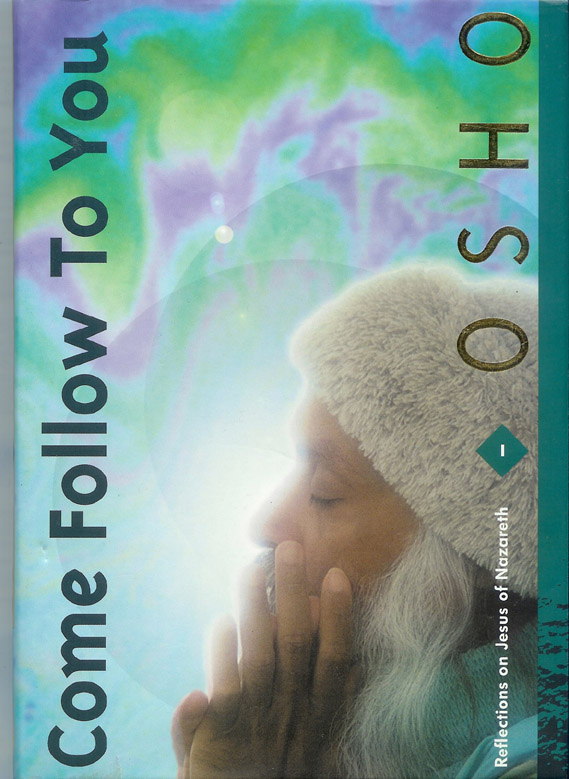
Come Follow To You, Vol 1
Discourses
Table of Contents
And the Word was Made Flesh
Christ is a rebel; Christianity is anti-Christ. Christ is the bridge between human agony and divine ecstasy—both like you and utterly unlike. 'In the beginning was the Word' means God is creativity, not a historical event. The Word is a pointer to the nameless. Jews denied Jesus because waiting itself had become their religion.
Gods in Exile
Four models of master-disciple: John the Baptist preceded Jesus (created limitations), Ramakrishna preceded Vivekananda (disciple distorted the message), Krishnamurti denied both predecessors and successors (negative freedom, no creation), and Osho's fourth way—both predecessor and successor, via positiva, inherently contradictory but totally free.
And, Lo, The heavens Opened
The world is maya—you own nothing, empty-handed you come and go. 'Repent' means return, not regret. 'The kingdom of heaven is at hand' means you are ending, not the world. Your eyes must be cleaned of this world to see the other. Death confronts you with the dream; religion begins when nothing belongs to you.
Mirroring Christ
Christianity is anti-Christ—Christ cannot be organized. A living master is the only living scripture; meditations are excuses to linger in his presence. The Bible has awe but priests destroy it through mediocre interpretation. Jesus was a peasant with raw wisdom, not knowledge—he wouldn't fit at Oxford or Cambridge.
And He Saith unto them: Follow me
Jesus's baptism was ego death—God enthroned. Either you exist or God exists. Knowing versus knowledge: a master shares nothingness, not information. Jesus preached immediately after enlightenment because knowing wants to be shared instantly. The master shouts: 'Enthrone Me!'—disappear and let God enter.
The luxury of God
Privacy and secrecy are essential for inner growth—seeds need darkness to sprout. Public life loses the soul; Marilyn Monroe's suicide was the only private act left. Balance: go within for energy, come out to share. Touch reveals what eyes cannot. A few chapters open, a few completely closed—never be just an open book.
I am not come to call the righteous
Religion is rebellion, not conformity. Belonging comes from fear; religion is freedom and aloneness. Conformity is mechanical—your signature perfect but dead. Religion is between individual and existence, not individual and society. Truth versus facts: that which changes is fact, that which remains is truth. Religion belongs to eternity.
God: The ultimate synthesis
Doubt and trust are both methods—use doubt for science, trust for religion. You are neither; you are transcendental awareness. India erred with trust-only (poverty), the West with doubt-only (spiritual barrenness). God is ultimate synthesis; the atom is ultimate analysis. Use both wings. Don't discard doubt—it has its rightful use.
Go thou and preach the kingdom of god
The lily pond parable: urgency is needed—postponing religion is fatal. Possessions suffocate life. People prepare to live but never actually live; rehearsals go on and the real drama never starts. Following a master means total commitment—no looking back, no conditions. 'Let the dead bury their dead'—religion is now or never.
Moving towards Christhood
Osho cries seeing disciples' misery—compassion is the criterion of enlightenment. Buddha waited at the door until the last being entered. Poetry happens when the poet is absent—like pregnancy, it comes from the beyond. The poet is born when poetry is born, not before. Real poetry is God writing through you; the poet is just a vehicle.