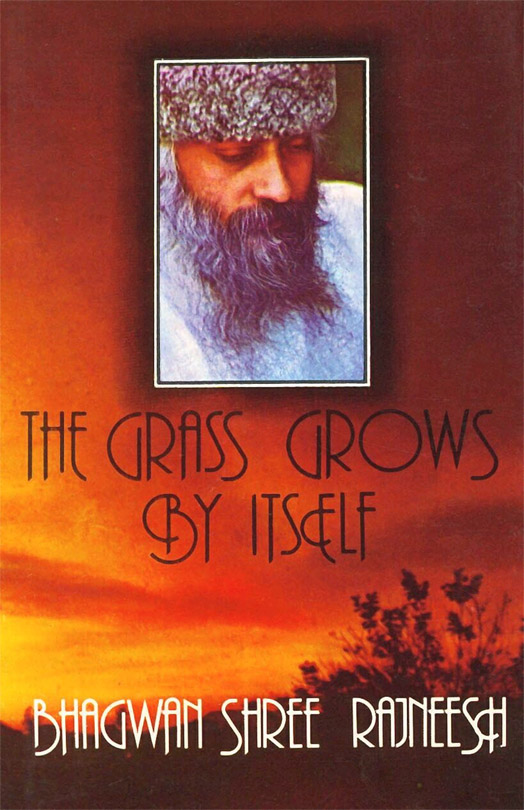
The Grass Grows By Itself
Discourses
Table of Contents
The Significance of Zen
The Significance of Zen. Bokuju: 'We dress and eat every day—how to get out of all that?' 'We dress, we eat.' 'I don't understand.' 'Put on your clothes and eat your food.' Zen was born in India, grew in China, blossomed in Japan—a rare phenomenon. It happened only once in human consciousness. The significance of Zen: don't try to get out of ordinary life—be fully in it. The grass grows by itself: enlightenment is not an achievement but a natural happening when you stop interfering.
Master and Disciple
Master and Disciple. Lieh Tzu: 'Three years serving the master—my mind no longer dared think right or wrong. Five years—mind again thinking right and wrong; the master smiled. Seven years—thinking without distinguishing right and wrong; the master pulled me to sit with him. Nine years—no knowing whether right or wrong was mine or another's.' The greatest art is to be a disciple—receptive, feminine, a womb. Truth is not found by aggression but by deep passivity. Water seeks hollow ground. The disciple receives like a pregnancy.
Emptiness and the Monk's Nose
Emptiness and the Monk's Nose. 'Can you get hold of emptiness?' The monk cupped his hands in the air. 'Not very good.' 'Show me a better way.' Sekkyo seized the monk's nose and yanked it. 'Ouch!' 'That's the way to get hold of emptiness.' Man is too full of himself—be like a hollow bamboo so existence can pass through. Emptiness is the highest bliss. You resist everything like a hard steel rod—nothing passes through. The monk's nose: emptiness is not abstract—it's painfully immediate, right here.
The Cataract at Luliang
The Cataract at Luliang. Confucius saw an old man go into a deadly cataract—then emerge caroling. 'Is there any way to deal with the water?' 'No way—plunging in with the whirl, coming out with the swirl. I accommodate myself to the water, not the water to me.' There is only one problem: the ego. Cut the root, not the leaves. The old man in the cataract: don't fight existence—flow with it. Accommodate yourself to the water. The grass grows by itself.
The 'Master of Silence'
The 'Master of Silence'. A fraud monk had two eloquent attendants answer for him. A pilgrim came when they were absent: 'What is Buddha?' The master looked desperately around. The pilgrim was satisfied: 'He looked east and west—Buddha is not found in any direction!' When the attendants returned, the master scolded them. Life is a mystery—the more you know, the less you feel you know. Silence is the only expression. But in religion, frauds can deceive because there's no empirical test. The master of silence was a fraud—true silence is not pretension.
Awakening
Awakening. Koshu trained three years with no satori. He vowed: 'Either I realize my dreams or you'll find my body at the foot of this tower.' He lifted his leg over the railing—at that instant, awakening. 'Bravo! You've finally had your day.' Man is the only animal who can commit suicide—fragmentary consciousness creates the problem. Total consciousness or total unconsciousness: both are beyond problems. The moment of jumping is the awakening—the edge of death becomes the edge of birth.
Not a Dead One
Not a Dead One. The ex-emperor: 'What happens to an enlightened man after death?' Gudo: 'How should I know?' 'Why? You are a master.' 'Yes, but not a dead one!' Man is ignorant of the real because to know the real, first you must be the real. Man is a hypocrite—many faces, no original face. Philosophy is a trick to deceive oneself about ignorance. The master is alive—he knows the living truth, not speculation about death. Not a dead one: enlightenment is alive, present, here.
A Field Dyed Deep Violet
A Field Dyed Deep Violet. Ninagawa visited Ikkyu: 'Who are you?' 'A devotee of Buddhism.' 'From?' 'Your region.' 'What's happening there?' 'Crows caw, sparrows twitter.' 'Where are you now?' 'In a field dyed deep violet.' 'Why?' 'Miscanthus, morning glories, safflowers...' Ikkyu served him tea: 'I want to serve you delicacies. Alas! The Zen sect can offer nothing.' The visitor replied in verse. A field dyed deep violet: the ordinary world IS the pure land. Crows cawing, sparrows twittering—this is Buddha. The grass grows by itself.