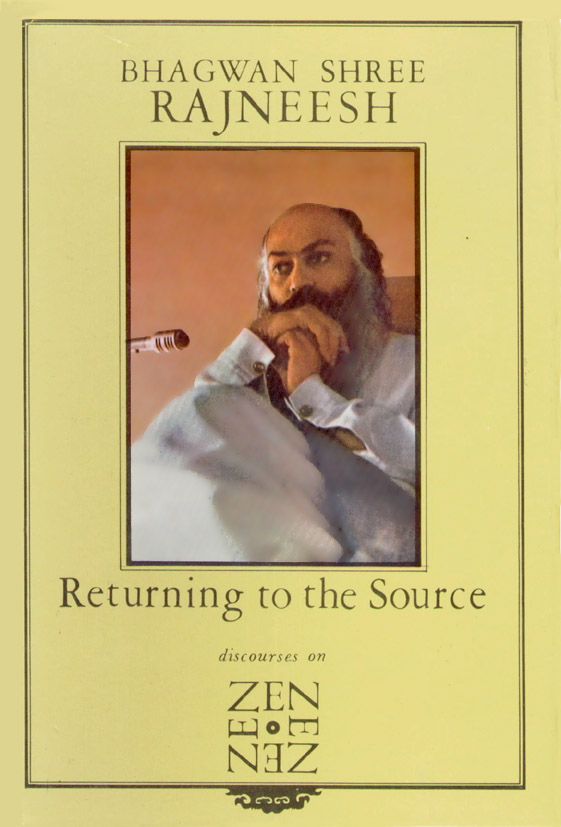
Returning to the Source
Discourses
Table of Contents
One Short Note
One Short Note. Kakua was asked to preach Zen to the emperor. He blew one note on a flute, bowed, and disappeared. One short note: the single note is emptiness. It says all that can be said. Kakua didn't preach because Zen can't be preached. The flute's note is the closest expression—the sound of silence.
Throw It Out!
Throw It Out! 'I have nothing in my mind—now what?' Joshu: 'Throw it out! If you can't throw it out, carry it out, drive it out—don't stand with nothing in your mind!' Throw it out: even 'nothing' is something. Even emptiness becomes a concept. The ego can make a possession of nothingness. Don't stand with nothing—go beyond nothing.
It Is Very Sharp
It Is Very Sharp. Nansen cutting trees. A monk asked: 'Is the abbot at home?' The woodcutter: 'I bought this axe for two pieces of copper. It is very sharp.' It is very sharp: Zen is nothing special—the axe is ordinary, the master is ordinary. Don't seek the extraordinary—find the extraordinary in the ordinary.
Suppose My Hand Were Always Like That?
Suppose My Hand Were Always Like That? Mokusen held his fist before the stingy wife. 'Suppose my hand were always like that?' 'Deformed.' Open hand: 'Suppose always like that?' 'Another deformity.' Suppose my hand were always like that: both tightfistedness and forced generosity are deformities. The natural hand opens and closes. Be natural—flow with the moment.
How Does Buddhism Explain Egotism
How Does Buddhism Explain Egotism. The prime minister asked about egotism. The master turned blue: 'What are you saying, you numskull?' The minister got angry. The master smiled: 'This is egotism.' How does Buddhism explain egotism: the master demonstrates egotism by provoking it. Ego is not a concept to explain—it's an experience to see in yourself.
Where Can You Go And Not Be Loved
Where Can You Go And Not Be Loved. The innkeeper valued his ugly concubine, neglected the beautiful one. 'The beautiful one thinks herself beautiful—I don't notice her beauty.' Where can you go and not be loved: when you don't think yourself noble, everyone loves you. Self-consciousness repels; naturalness attracts. Drop the thought of yourself.
Snowflakes As Beautiful As These Don't Fall
Snowflakes As Beautiful As These Don't Fall. Houn: 'Snowflakes as beautiful as these don't fall elsewhere.' 'Where is this elsewhere?' He slapped the disciple. Snowflakes as beautiful as these don't fall elsewhere: there is no elsewhere—this moment is all. The disciple asked about elsewhere—the master's slap brings him back here.
The First Principle
The First Principle. Master Kosen wrote 'The First Principle' sixty-four times—each rejected by the pupil. When the pupil left for ink, Kosen did a quick one—'A masterpiece!' The first principle: when the mind of judging is absent, the masterpiece appears. Perfection comes when you stop trying. The sixty-four failures were the ego—the sixty-fifth was natural.
He Did Not Feel It So Deeply
He Did Not Feel It So Deeply. An old man wept at a fake tomb—when he reached the real one, he didn't feel it so deeply. He did not feel it so deeply: the mind creates emotions, not reality. The imagined provoked tears; the real didn't. The mind projects feelings onto things. When you see the real, the mind's drama subsides.
So Teng Died Standing On His Head
So Teng Died Standing On His Head. Teng asked: 'Has anyone died standing on his head?' He did—and his clothes stayed up. His nun sister prodded him—he fell. So Teng died standing on his head: even death is a play for the Zen master. He defies convention even in dying. The sister's prod brings him back to ordinary—even the extraordinary must become ordinary again.