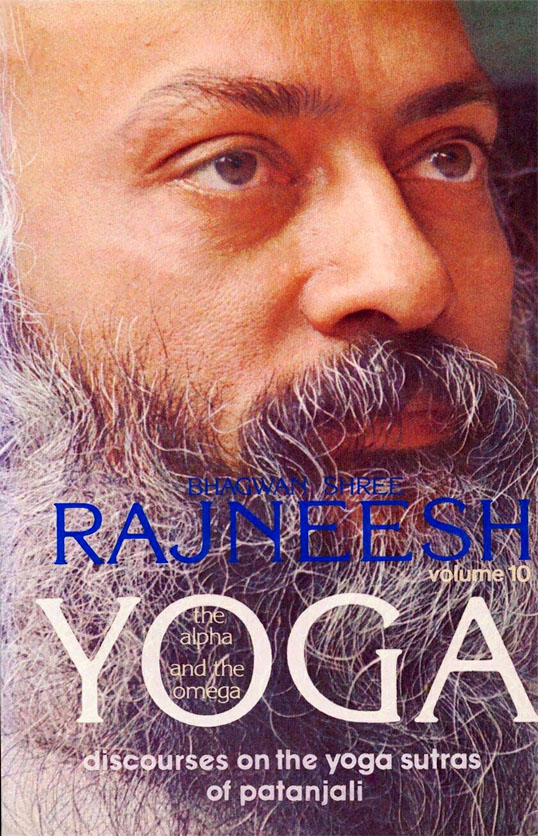
Yoga: The Alpha and the Omega, Vol 10
Discourses
Table of Contents
Dropping the artificial mind
Dropping the artificial mind. The mind is artificial—it's a social construct. Dropping the artificial mind: the mind you think with is not yours—it's society's implant. Language, culture, religion—all artificial. The natural mind is no-mind. Drop the artificial and the natural appears. You were born with no-mind; the mind was imposed.
Aloneness is the last achievement
Aloneness is the last achievement. Kaivalya—the state of absolute aloneness. Aloneness is the last achievement: not the first but the last. You must pass through love, through relationship, through communion—then aloneness. It's not isolation—it's indivisibility. The last achievement is the realization that you were always alone—and that aloneness is bliss.
Returning to the original mind
Returning to the original mind. Before the imposed mind, there was the original mind—pure consciousness. Returning to the original mind: the original mind is not a mind at all—it's pure awareness, before conditioning. The journey is not forward but backward—unlearning, unconditioning. The original mind is the mirror—empty, reflecting, not grasping.
Everything is interdependent
Everything is interdependent. Nothing exists independently—Pratitya Samutpada, dependent origination. Everything is interdependent: no thing stands alone. You exist because everything else exists. This understanding kills the ego—the ego wants independence. Seeing interdependence, you see you're part of the whole. The whole is the only reality.
This is it!
This is it! The ultimate recognition—this moment is all. This is it! The last exclamation of the yogi: not somewhere else, not some other time—THIS is it. The search ends when you realize the sought was always the seeker. This moment, this breath, this awareness—it IS enlightenment. No more seeking. Just being.
Without any choice of your own
Without any choice of your own. The highest state is choiceless—no personal will. Without any choice of your own: the yogi doesn't choose—existence chooses through him. Like a leaf in the wind—carried, not controlling. This is not passivity—it's supreme intelligence. When the ego doesn't choose, the divine chooses.
The witness is self-illuminating
The witness is self-illuminating. The witness doesn't need an external light—it's its own light. The witness is self-illuminating: consciousness doesn't need anything to be conscious of—it's luminous by nature. Like the sun doesn't need another sun to see itself. The witness is the light; the mind is the shadow. Know the witness.
Trust is unaddressed
Trust is unaddressed. True trust is not directed at anyone—it's a state. Trust is unaddressed: trust is not to a person or a god—it's a quality of being. You don't trust someone—you ARE trust. Like the flower doesn't trust the sun—it simply opens. Trust is openness, unaddressed, total.
Kaivalya
Kaivalya. The final chapter of Patanjali's Yoga Sutras—absolute aloneness. Kaivalya: the culmination of yoga—not union but aloneness. Paradox: union (yoga) ends in aloneness (kaivalya). Because in ultimate union, the distinction between united and unifier dissolves. What remains is alone—indivisible, absolute. The last word of yoga: you are alone, and that aloneness is everything.
I am in favor of love
I am in favor of love. The closing statement—love is the ultimate. I am in favor of love: after 10 volumes of yoga, the master says: love. Yoga without love is dead. Love without yoga is blind. Together they are the complete human. The last word is not samadhi, not kaivalya—it's love. Zorba the Buddha: the yogi who loves.